Today, October 4, 2025

Today's
EarthStation1.com 15% Off Commemorative Memorial Title:
Revelation: The History Of Christianity DVD, Video Download, USB
Drive
Today, October 4, 2025
October 4: Feast Day Of Saint Francis: --
Francis of Assisi, venerated as Saint Francis of Assisi, also
known in his ministry as Francesco, Italian Catholic friar,
deacon, philosopher, mystic, teacher and preacher, is celebrated
by the Feast of Saint Francis of Assisi every October 4. He
founded the men's Order of Friars Minor and the women's Order of
Saint Clare, among many others. This saint led a colorful and
interesting life before devoting his life to God and becoming one
of the most renowned Christians of all time. To celebrate him and
commemorate his journey to the afterlife, the town of Assisi
lights oil lamps for two days. Religious services are held and
some children even bring their pets to be blessed on this day. On
October 3, 1226, Francis of Assisi (b. c. 1181), one day earlier
than his feast day would be, died by choice in the humble hut the
Franciscan Movement begain in, next to the Porziuncola, a small
Catholic church now located inside the grand Papal Basilica of
Saint Mary of the Angels in Assisi, during the evening hours while
listening to a reading he had requested of Psalm 142 (Psalm 141 in
different numbering systems, "Voce Mea Ad Dominum"
(Latin: "To The Lord"), which he sang along with:
========= "I cry aloud to the Lord; I lift up my voice to the
Lord for mercy. I pour out before him my complaint; before him I
tell my trouble. When my spirit grows faint within me, it is you
who watch over my way. In the path where I walk people have hidden
a snare for me." ========= The Basilica of St. Francis of
Assisi, which enshrines the remains of the Saint, stands upon a
hill that in the early 1200s was commonly known as the "Colle
dell'Inferno" [Hill of Hell]. This was probably because it
was a place where death sentences were carried out. It also
functioned as a kind of city dump. Francis died in the Portiuncula
church in the evening of October 3, 1226. His body was immediately
brought within the walls of the City of Assisi and was buried in
the Chapel of San Giorgio, which later became part of the Basilica
of St. Clare and is known today as the Chapel of the Crucifix.
During the spring of 1227, the Colle dell'Inferno was donated to
Pope Gregory IX. The pope ordered a basilica to be built there to
house the body of St. Francis. Work began in the summer of 1227
and by the end of May, 1230 Francis' body was solemnly transferred
to the new basilica and placed below the main altar. The pope
proclaimed the new Basilica as the "Caput et Mater"
[Head and Mother] of the entire Order of Friars Minor. The
architectural planning was entrusted to Brother Elias of Cortona,
a companion of St. Francis and the Minister General of the Order
of Friars Minor. Brother Elias ordered the construction of a lower
basilica, intended as a crypt, and an upper basilica, in Gothic
style, for large celebrations. The upper basilica was erected
immediately after the lower basilica. Great artists were called to
fresco the walls of this complex, such as Cimabue, Giotto, Simone
Martini, and Pietro Lorenzetti. They painted stories from the life
of Christ and characters from the Old Testament as well as images
of St. Francis and other saints. On the vaults above the main
altar of the lower basilica, painted by Giotto, we find the Glory
of St. Francis depicted along with allegories of the religious
vows of poverty, chastity and obedience. The side walls of the
upper basilica feature twenty-eight large frescoes showing scenes
from the life of St. Francis. These are attributed to Giotto and
his collaborators. In the post-Napoleonic era, excavations were
made to determine the exact burial place of St. Francis and
conduct a recognition of his body. Thus, the crypt was built,
which was later reworked in the neo-Romanesque style we see today.
Since then, the millions of pilgrims, tourists and devotees who
visit Assisi every year are given close access to the tomb of the
Seraphic Father St. Francis. His tomb is surrounded by the tombs
of four of his closest friars: Leo, Masseo, Angelo and Rufino.
Also nearby is the tomb of "Friar" Jacopa, the noble
Roman woman and Franciscan tertiary who was very close to Francis.
Pope St. John XXIII, Pope St. John Paul II, Pope Benedict XVI and
Pope Francis made several pilgrimages to the tomb of St. Francis,
in particular, to ask for the gift of peace, in communion with men
and women from other Christian communities and from different
faiths. Pope Francis specifically chose October 3, 2020, as the
day to sign Fratelli tutti, his encyclical on fraternity and
social friendship. Despite the Covid-19 pandemic, this event took
place on the altar of the crypt, at the foot of the urn that holds
the remains of St. Francis. Francis Of Assisi was #born in Assisi,
Umbria, Italy as Giovanni di Pietro di Bernardone. He renounced
his family's wealth, took a vow of poverty and founded the Order
Of Friars Minor, also known as the Franciscan Order. He founded
the men's Order of Friars Minor, the women's Order of Saint Clare,
the Third Order of Saint Francis and the Custody of the Holy Land.
Francis is one of the most venerated religious figures in
Christianity. Pope Gregory IX canonized Francis on July 16, 1228.
Along with Saint Catherine of Siena, he was designated patron
saint of Italy. He later became associated with patronage of
animals and the natural environment, and it became customary for
churches to hold ceremonies blessing animals on or near his feast
day of October 4. In 1219, he went to Egypt in an attempt to
convert the Sultan to put an end to the conflict of the Crusades.
By this point, the Franciscan Order had grown to such an extent
that its primitive organizational structure was no longer
sufficient. He returned to Italy to organize the Order. Once his
community was authorized by the Pope, he withdrew increasingly
from external affairs. Francis is also known for his love of the
Eucharist. In 1223, Francis arranged for the first Christmas live
nativity scene. According to Christian tradition, in 1224 he
received the stigmata during the apparition of Seraphic angels in
a religious ecstasy, which would make him the second person in
Christian tradition after St. Paul (Galatians 6:17) to bear the
wounds of Christ's Passion. On Sale @ 15% Off Discount Till
Midnight PT!
https://store.earthstation1.com/revelation-the-history-of-christianity-documentary.html
Today's
EarthStation1.com 15% Off Commemorative Memorial Title: The Old
Time Radio Drama MP3 MegaSet DVD, Audio Download, USB Stick
Today, October 4, 2025
October 4, 1883: The History Of Rail
Transport (The History Of Railways): The History Of Rail
Transportation In Europe: First Runs (Railroads): The Orient
Express (The Express d'Orient): -- The first full run of the
Express d'Orient, renamed The Orient Express in 1891, departs from
Gare de l'Est railway station in Paris to Giurgiu in Romania via
Munich and Vienna. At Giurgiu, passengers were ferried across the
Danube to Ruse, Bulgaria, to pick up another train to Varna. They
then completed their journey to Constantinople by ferry. Prior to
this, the first Express d'Orient left Paris for Vienna on June 5,
1883, with Vienna remaining the terminus of the run until the
October 4, 1883 full run date. In 1885, another route began
operations, this time reaching Constantinople via rail from Vienna
to Belgrade and Nis, carriage to Plovdiv, and rail again to
Istanbul. The two city names most prominently associated with the
Orient Express are Paris and Constantinople (Istanbul), the
original endpoints of the timetabled service. On Sale @ 15% Off
Discount Till Midnight PT!
https://store.earthstation1.com/the-old-time-radio-drama-mp3-dvd-megase3.html
Today's
EarthStation1.com 15% Off Commemorative Memorial Title: The Genius
That Was China Documentary Series DVD, Download, USB Drive
Today, October 4, 2025
October 4, 1363: Greatest Naval Battles:
The Mongols: The Mongol Empire: The Royal House Of Borjigin: The
Chinese Dynasties (The Dynasties Of China, The Chinese Monarchy):
The Yuan Dynasty (Chinese: Yuanchao) (The Great Yuan): The Red
Turban Rebellions (Chinese: Hongjin Qiyi): The Battle Of Lake
Poyang (Chinese: Poyang Hu Zhizhan): -- The largest naval battle
in history in terms of personnel, the five-week Battle Of Lake
Poyang (August 30-October 4, 1363), ends when the Ming General Zhu
Yuanzhang's fire ships destroy the remaining fleet of the Chen
Han, whose leader General Chen Youliang was killed in the battle
when an arrow strikes his head. A reported 850,000 sailors and
soldiers involved; a rebel force of Ming (a han people of the
Yellow River Basin), said to be 200,000 strong, commanded by Zhu
Yuanzhang, met a rebel force of Chen Han (a middle Yangtze
dynasty), claimed to be 650,000-strong, commanded by the Chen Han
Dynasty founder Chen Youliang. The battle was fought to decide who
would supplant the Yuan dynasty during the Red Turban Rebellions,
which were uprisings against the Yuan Dynasty that had been
established in 1351 by the Mongol leader of Borjigin clan Kublai
Khan, uprisings which eventually led to the overthrow of Mongol
rule in China and thereby the fall of the Yuan dynasty in 1368
with the establishment of Zhu Yuanzhang as Emperor Hongwu, the
first Emperor of the Ming Dynasty. Chen Youliang besieged Nanchang
with a large fleet on Lake Poyang, the largest freshwater lake in
China, and Zhu Yuanzhang met his force with a smaller fleet. After
an inconclusive engagement exchanging fire, Zhu employed fire
ships to burn and destroy the Han fleet of Louchuan ships, tower
ships central to Han fleets used as floating fortresses, equipped
for boarding and attacking enemy vessels and with siege weapons
such as traction trebuchets, a type of catapult that uses a long
arm to throw a projectile, for ranged combat. This was the last
major battle of the rebellion prior to the rise of the Ming
dynasty. On August 30 , the forces of Chen Han conducted a major
amphibious assault on Nanchang with a hundred vessels and several
hundred troops. The town of Nanchang was strategically located to
guard Lake Poyang, which connected the Yangtze River with other
river basins via the Gan, Xin, and Xiu rivers. During the early
1360s Zhu Yuanzhang held key garrisons on the lake and
administered them from Nanjing 560 kilometers downriver. Chen
Youliang tried to deposit his troops on the city walls with "tower
ships". This proved futile as the city defenders simply moved
the walls back and Chen was forced to personally lead an assault
on the city gates. They were repelled with a barrage of cannonfire
and driven back. After this failure, Chen set up a blockade,
determined to starve out the defenders, but a small fishing boat
managed to slip out and reached Nanjing in time to warn Zhu
Yuanzhang. Zhu Yuanzhang's fleet arrived at Poyang Lake on August
29 with a force only a third the size of Chen's army. According to
one Ming source, Zhu's forces arrived armed with "fire bombs,
fire guns, fire arrows, fire seeds [probably grenades], large and
small fire lances, large and small 'commander' fire-tubes, large
and small iron bombs, rockets." This shows that older
gunpowder weapons co-existed alongside guns, and proto-guns such
as fire lances were not supplanted until after early Ming. A new
weapon called the "No Alternative" was also mentioned.
The No Alternative was "made from a circular reed mat about
five inches around and seven feet long that was pasted over with
red paper and bound together with silk and hemp- stuffed inside it
was gunpowder twisted in with bullets and all kinds of
[subsidiary] gunpowder weapons." It was hung from a pole on
the foremast, and when an enemy ship came into close range, the
fuse was lit, and the weapon would supposedly fall onto the enemy
ship, at which point things inside shot out "and burned
everything to bits, with no hope of salvation." On August 30,
Zhu's fleet engaged Chen's under orders to "get close to the
enemy's ships and first set off gunpowder weapons (???), then bows
and crossbows, and finally attack their ships with short range
weapons." Fire bombs were hurled using naval trebuchets and
the Ming succeeded in "burning twenty or more enemy vessels
and killing or drowning many enemy troops," but their own
flagship also caught fire and hit a sandbar, forcing them to
withdraw. On August 31, the Ming rammed the enemy fleet with fire
ships. While guns were used during the battle, ultimately they
were not pivotal to success, and the battle was won using
incendiary weapons. On September 2, the two fleets engaged in
battle again, but the tide turned on Chen's forces, and they were
forced to withdraw. Afterwards, Zhu's fleet settled into a
blockade for another month until they employed fire ships again on
October 4, destroying the rest of Chen's fleet. Chen Youliang was
killed when an arrow struck his head. Chen Youliang was succeeded
by his son, Chen Li, who surrendered to Zhu in 1364. The Ming
victory here cemented their position as the leading rebel group.
Five years later, the Ming would overthrow the Yuan and take
command over China. Zhu Yuanzhang then became the first Emperor of
the Ming Dynasty as Hongwu. On Sale @ 15% Off Discount Till
Midnight PT!
https://store.earthstation1.com/the-genius-that-was-china-dvd-tv-documentary-series-2-disc-se2.html
Today's
EarthStation1.com 15% Off Commemorative Memorial Title: Buster
Keaton: A Hard Act To Follow TV Miniseries DVD, Download, USB
Today, October 4, 2025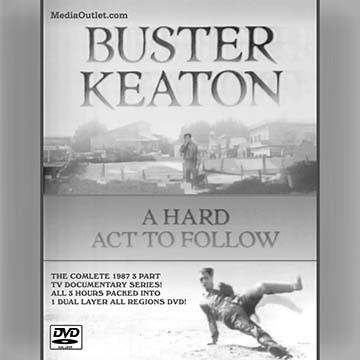
October 4, 1895: #BOTD: #HBD! Buster
Keaton, American actor, comedian, film director, producer,
screenwriter, and stunt performer (d. February 1, 1966) is #born
Joseph Frank Keaton to a vaudeville family in Piqua, Kansas, the
small town where his mother, Myra Keaton (nee Cutler), was when
she went into labor. Buster Keaton was best known for his silent
films, in which his trademark was physical comedy with a
consistently stoic, deadpan expression, earning him the nickname
"The Great Stone Face." Critic Roger Ebert wrote of
Keaton's "extraordinary period from 1920 to 1929, he worked
without interruption on a series of films that make him, arguably,
the greatest actor-director in the history of the movies".
His career declined afterward with a dispiriting loss of his
artistic independence when he was hired by Metro-Goldwyn-Mayer and
he descended into alcoholism, ruining his family life. He
recovered in the 1940s, remarried, and revived his career to a
degree as an honored comic performer for the rest of his life,
earning an Academy Honorary Award in 1959. Many of Keaton's films
from the 1920s, such as Sherlock Jr. (1924), The General (1926),
and The Cameraman (1928), remain highly regarded, with the second
of these three widely viewed as his masterpiece. Among its
strongest admirers was Orson Welles, who stated that The General
was cinema's highest achievement in comedy, and perhaps the
greatest film ever made. Keaton was recognized as the
seventh-greatest film director by Entertainment Weekly, and in
1999, the American Film Institute ranked him the 21st greatest
male star of classic Hollywood cinema. Buster Keaton died of lung
cancer aged 70 in Woodland Hills, Los Angeles, California. Despite
being diagnosed with cancer in January 1966, he was never told he
was terminally ill. Keaton thought that he was recovering from a
severe case of bronchitis. Confined to a hospital during his final
days, Keaton was restless and paced the room endlessly, desiring
to return home; the day before he died, Keaton was up out of bed
and moving around, and even played cards with friends who came to
visit. He is buried at Forest Lawn Memorial Park Cemetery in
Hollywood Hills, California. On Sale @ 15% Off Discount Till
Midnight PT!
https://store.earthstation1.com/buster-keaton-a-hard-act-to-follow-dvd-all-3-tv-show3.html
Today's
EarthStation1.com 15% Off Commemorative Memorial Title: The Race
For Space 1961 Historic Soviet Space Films DVD, Download, USB
Today, October 4, 2025
October 4, 1957: Rocket Launches: The
History Of Rocketry: The History Of Spaceflight: The Aftermath Of
World War II: The Cold War: The Space Age: The Space Race: The
Soviet Space Program: Earth Satellites: The Sputnik Program
(Sputnik Spacecraft): Sputnik 1 (Russian: "Satellite-1";
Prosteyshiy Sputnik-1 or PS-1, "Elementary Satellite 1,
Sputnik I): -- The Space Age begins as the Soviet Union launches
the first man-made satellite into orbit. Sputnik 1 weighed just
184 lbs. and transmitted a beeping radio signal for 21 days. The
Soviet Union launched it into an elliptical low Earth orbit. It
was a 58 cm (23 in) diameter polished metal sphere, with four
external radio antennas to broadcast radio pulses. It was visible
all around the Earth, and its radio pulses were detectable. This
surprise success precipitated the American Sputnik crisis and
triggered the Space Race, a part of the Cold War. The launch
ushered in new political, military, technological, and scientific
developments. Tracking and studying Sputnik 1 from Earth provided
scientists with valuable information, even though the satellite
itself wasn't equipped with sensors. The density of the upper
atmosphere could be deduced from its drag on the orbit, and the
propagation of its radio signals gave information about the
ionosphere. Sputnik 1 was launched during the International
Geophysical Year from Site No.1/5, at the 5th Tyuratam range, in
Kazakh SSR (now known as the Baikonur Cosmodrome). The satellite
travelled at about 29,000 kilometres per hour (18,000 mph; 8,100
m/s), taking 96.2 minutes to complete each orbit. It transmitted
on 20.005 and 40.002 MHz, which were monitored by amateur radio
operators throughout the world. The signals continued for until
the transmitter batteries ran out on 26 October 1957. Sputnik
burned up on 4 January 1958 while reentering Earth's atmosphere,
after three months, 1440 completed orbits of the Earth, and a
distance travelled of about 70 million km (43 million mi). The
Soviet accomplishment sent a shockwave through the American
political leadership resulting in U.S. efforts to be the first on
the moon. On Sale @ 15% Off Discount Till Midnight PT!
https://store.earthstation1.com/the-race-for-space-dvd-1961-secret-soviet-f1961.html
Today's
EarthStation1.com 15% Off Commemorative Memorial Title: De Gaulle
And France TV Series DVD, Video Download, USB Flash Drive
Today, October 4, 2025
October 4, 1958: France: The History Of
France: The Modern History Of France: Governments Of France: The
Aftermath Of World War II: The French Fifth Republic: -- The Fifth
Republic, France's current republican system of government, is
established by Charles de Gaulle under the Constitution of the
Fifth Republic, established on the same date. The Fifth Republic
emerged from the collapse of the Fourth Republic, replacing the
former parliamentary republic with a semi-presidential, or
dual-executive, system that split powers between a Prime Minister
as head of government and a President as head of state. De Gaulle,
who was the first French President elected under the Fifth
Republic in December 1958, believed in a strong head of state,
which he described as embodying l'esprit de la nation ("the
spirit of the nation"). The Fifth Republic is France's
third-longest political regime, after the hereditary and feudal
monarchies of the Ancien Regime (Late Middle Ages - 1792) and the
parliamentary Third Republic (1870-1940). The current Constitution
of France, typically called the Constitution of the Fifth
Republic, replaced that of the Fourth Republic dating from 1946.
Charles de Gaulle was the main driving force in introducing the
new constitution and inaugurating the Fifth Republic, while the
text was drafted by Michel Debre. Since then the constitution has
been amended twenty-four times, most recently in 2008. On Sale @
15% Off Discount Till Midnight PT!
https://store.earthstation1.com/de-gaulle-and-france-3-part-tv-documentary-series-2-disc-dvd-s32.html
Today's
EarthStation1.com 15% Off Commemorative Memorial Title: Color
Adjustment 40 Years Of Black America On Broadcast TV DVD MP4 USB
Today, October 4, 2025
October 4, 2019: #DOTD: #RIP: Diahann
Carroll, African American actress, singer, model, activist and
beauty, whose 1968 debut in Julia, the first series on American
television to star a Black woman in a non-stereotypical role, was
a milestone both in her career and the medium (b. July 17, 1935)
#dies of breast cancer at her home in West Hollywood, California
at the age of 84. Carroll also had dementia at the time of her
death, though actor Marc Copage, who played her character's son on
her television series Julia, said that she did not appear to show
serious signs of cognitive decline as late as 2017. She is buried
at Woodlawn Cemetery in The Bronx, New York. Born Carol Diann
Johnson in the Bronx, New Yor\k City, she rose to prominence in
some of the earliest major studio films to feature black casts,
including Carmen Jones (1954) and Porgy and Bess (1959). In 1962,
Carroll won a Tony Award for best actress, a first for an African
American woman, for her role in the Broadway musical No Strings.
In 1974 she starred in Claudine alongside James Earl Jones for
which she received an Academy Award for Best Actress nomination.
In the 1980s, she played the role of Dominique Deveraux, a
mixed-race diva, in the prime time soap opera Dynasty. Carroll was
the recipient of numerous stage and screen nominations and awards,
including the Golden Globe Award for Best Actress In a Television
Series in 1968. On Sale @ 15% Off Discount Till Midnight PT!
https://store.earthstation1.com/color-adjustment-40-years-of-black-americans-on-tv-dvd-download-u40.html
Today's
EarthStation1.com 15% Off Commemorative Memorial Title: The Golden
Age Of Rock 'N' Roll DVD, MP4 Video Download, Flash Drive
Today, October 4, 2025
October 4, 1970: #DOTD: #RIP: Janis
Joplin, American singer, songwriter and guitarist, one of the
biggest female rock stars of her era (b. January 19, 1943) #dies
of a heroin overdose in Los Angeles, California at age 27.
Joplin's death stunned her fans and shocked the music world,
especially when coupled with the death just 16 days earlier of
another rock icon, Jimi Hendrix, also at age 27. This would later
cause some people to attribute significance to the death of
musicians at the age of 27, as celebrated in the "27 Club."
Her remains were cremated, and the ashes were scattered by plane
into the Pacific Ocean along Stinson Beach, California. She was
born Janis Lyn Joplin in Port Arthur, Texas. She releasing three
albums prior to her death; a fourth album, Pearl, was released in
January 1971, just over three months after her death. It reached
number one on the Billboard charts. In 1967, Joplin rose to fame
during an appearance at Monterey Pop Festival, where she was the
lead singer of the then little-known San Francisco psychedelic
rock band Big Brother and the Holding Company. After releasing two
albums with the band, she left Big Brother to continue as a solo
artist with her own backing groups, first the Kozmic Blues Band
and then the Full Tilt Boogie Band. She appeared at the Woodstock
festival and the Festival Express train tour. Five singles by
Joplin went into the Billboard Hot 100, including a cover of the
song "Me and Bobby McGee", which reached number 1 in
March 1971. Her most popular songs include her cover versions of
"Piece of My Heart", "Cry Baby", "Down on
Me", "Ball 'n' Chain", and "Summertime";
and her original song "Mercedes Benz", her final
recording. Joplin, highly respected for her charismatic performing
ability, was posthumously inducted into the Rock and Roll Hall of
Fame in 1995. Audiences and critics alike referred to her stage
presence as "electric". Rolling Stone ranked Joplin
number 46 on its 2004 list of the 100 Greatest Artists of All Time
and number 28 on its 2008 list of 100 Greatest Singers of All
Time. She remains one of the top-selling musicians in the United
States, with Recording Industry Association of America
certifications of 15.5 million albums sold in the USA. On Sale @
15% Off Discount Till Midnight PT!
https://store.earthstation1.com/the-golden-age-of-rock-39n39-roll-dvd-complete-tv-series-5-39395.html
Today's
EarthStation1.com #OnThisDay Commemorative Memorial Title:
Vietnam: A Country Not A War - George Page Wildlife DVD, Download,
USB
Today, October 4, 2025 October 4: World Animal Day: -- Now's the
time for all animal-lovers to show us their compassion and we're
planning to make a big roar. Animals can't talk in the
conventional way that humans communicate with each other. But
there's one day where we can all give a voice to the animals who
can't speak for themselves. On October 4, people spanning the
globe will come together to celebrate World Animal Day. In any
corner of the planet, no matter which country you explore, animals
will consistently have a strong impact on the region's culture.
World Animal Day dates as far back as 1925 when Heinrich
Zimmermann organized the first celebration in Berlin. Zimmermann,
the publisher of a German animal lovers' magazine, "Man and
Dog," launched the event to raise awareness and improve the
welfare of animals. The date of October 4 is also known as the
feast day of Saint Francis of Assisi, the patron Saint of animals.
Beloved among all Catholics, Saint Francis was famously recognized
for his remarkable way with animals and all living things. Saint
Francis is also the chosen papal name for His Holiness himself,
Pope Francis. Some Catholic churches have even been known to offer
blessings to pets on this day in honor of all Saint Francis has
done for animals. World Animal Day has also become an arena for
ecologists to discuss the problems associated with endangered
species. Beginning in 2003, the UK-based charity, Naturewatch
Foundation, has sponsored the event and organized ways for animal
lovers all over the world to take part and make their voices heard
in support of our animal friends. This day is not just for
domesticated animals, it's for wild animals, endangered species,
and those threatened by environmental devastation or lack of
protection. This day is a reminder not just to love the animals in
our homes but to appreciate and respect all living things that are
a part of our ecosystem.
https://store.earthstation1.com/vietnam-a-country-not-a-war-dvd-wildlife-of-vietnam.html
October 4: World Animal Day: -- Now's the
time for all animal-lovers to show us their compassion and we're
planning to make a big roar. Animals can't talk in the
conventional way that humans communicate with each other. But
there's one day where we can all give a voice to the animals who
can't speak for themselves. On October 4, people spanning the
globe will come together to celebrate World Animal Day. In any
corner of the planet, no matter which country you explore, animals
will consistently have a strong impact on the region's culture.
World Animal Day dates as far back as 1925 when Heinrich
Zimmermann organized the first celebration in Berlin. Zimmermann,
the publisher of a German animal lovers' magazine, "Man and
Dog," launched the event to raise awareness and improve the
welfare of animals. The date of October 4 is also known as the
feast day of Saint Francis of Assisi, the patron Saint of animals.
Beloved among all Catholics, Saint Francis was famously recognized
for his remarkable way with animals and all living things. Saint
Francis is also the chosen papal name for His Holiness himself,
Pope Francis. Some Catholic churches have even been known to offer
blessings to pets on this day in honor of all Saint Francis has
done for animals. World Animal Day has also become an arena for
ecologists to discuss the problems associated with endangered
species. Beginning in 2003, the UK-based charity, Naturewatch
Foundation, has sponsored the event and organized ways for animal
lovers all over the world to take part and make their voices heard
in support of our animal friends. This day is not just for
domesticated animals, it's for wild animals, endangered species,
and those threatened by environmental devastation or lack of
protection. This day is a reminder not just to love the animals in
our homes but to appreciate and respect all living things that are
a part of our ecosystem.
https://store.earthstation1.com/vietnam-a-country-not-a-war-dvd-wildlife-of-vietnam.html
Today's
EarthStation1.com #OnThisDay Commemorative Memorial Title: Super
Sense Animal Perception/Plant Adaptation TV Series DVD, MP4, USB
Today, October 4, 2025October 4: Kindness To Animals Day (The
Philippines): -- A Philippines national holiday that began with a
proclamation issued by the 9th-President Of The Philippines Carlos
Polestico Garcia (In office March 18, 1957 - December 30, 1961).
The fact that a president of a country made that part of his
life's work shows that no matter who you are, what you do, or
where you come from, being compassionate towards animals is and
will always be a worthy cause. Pets, particularly dogs and cats,
have been scientifically proven to reduce stress, anxiety, and
depression, alleviate loneliness, and promote exercise and
playfulness. Caring for an animal can help children become more
secure and active as they grow older. Pets can also be a valuable
source of companionship for the elderly. But, it doesn't just end
with pets. Being kind to animals is a great way to get connected
with them on a deeper level out of respect and understanding.
Being kind to animals is good for you, those around you, and the
animals themselves. In the Philippines, Carlos Polestico Garcia, a
lawyer by profession, entered politics when he was elected to the
House of Representatives to represent the third district of Bohol.
He later became the eighth President of the Philippines. He was
known for being a teacher, poet, orator, lawyer, and political
economist who was passionate about animals and wildlife. So much
so that on September 30, 1958, in the City of Manila, Garcia
issued Proclamation No. 537 declaring the fourth day of October
each year as Kindness to Animals Day. The proclamation emphasized
the importance of instilling the virtues of kindness, justice, and
mercy in all living creatures and condemned all forms of cruelty
to both men and animals. Garcia called upon all citizens and
residents of the Philippines, government officials and employees,
public and private schools, churches, and civic organizations, to
observe this special day with ?programs and ceremonies so that all
people can get involved to showcase their compassion for animals.
https://store.earthstation1.com/super-sense--animal-perception-tv-series-dvd-mp4-download-usb-driv4.html
Today's
EarthStation1.com #OnThisDay Commemorative Memorial Title: War
Jets: The Tupolev Tu-22M Backfire Bomber MP4 Video Download Or DVD
Today, October 4, 2025October 4: National Vodka Day: -- In the
British sitcom, "Absolutely Fabulous," the only vodka
that is worth drinking is "Stoli." In that spirit, on
October 4, we raise our shot glasses in celebration of National
Vodka Day. To the uninitiated, vodka has a certain panache,
elevating it above all other liquors. Housed in a beautiful glass,
vodka is a status symbol -- elegance personified. This odorless,
flavorless beverage is closely associated with Eastern Europe.
Vodka has its roots in the Russian word, "voda," which
means "water." Although Russia and Poland have a fierce
rivalry over who actually invented vodka, it's rumored that the
drink was first produced in Russia in the 9th century. French and
Russian soldiers scattered throughout Europe during the 19th
century's Napoleonic era, eventually popularized the drink. Today,
vodka is the most widely-consumed spirit in the world - quite the
accomplishment! It may sound like a joke, but it isn't: The
Tupolev Tu-22M Backfire Bomber, the Soviet Union's first
supersonic bomber, earned the nickname "the supersonic booze
carrier" because it came equipped with an onboard vodka tank
-- "believe it or not!", as Jack Palance famously said
at the end of the each story of the Ripley's titular television
series.
https://store.earthstation1.com/war-jets-the-tupolev-tu-22m-backfire-bomber-mp4-video-download-or-dvd.html
Today's
EarthStation1.com #OnThisDay Commemorative Memorial Title:
American Business Films Of The 20th Century MP4 Video Download DVD
Today, October 4, 2025October 4: Improve Your Office Day: --
Marks the day when we declutter and make our workspace more
productive - and even uplift the spirits in our offices if
necessary! The concept of an office originated from the medieval
monks' scriptorium - a place for writing. But the concept became
formalized in the 18th century when the East India Company needed
a "bureaucracy to process information and make decisions"
about its newly acquired empire in India. Over the years, the
office has undergone different designs, sizes, and philosophies,
but it has always been within a designated building. The office
has come to signify any place where we get our job done, and that
can be in an office building, a coworking space, Starbucks, the
library, or even a corner in our house. While we may accept the
way we work now and the concept of an office may seem timeless,
the office does have a history, and it wasn't always as it is now.
The medieval monks created the first workplace in the 15th
century. The "scriptorium" was a cubicle-style desk made
for copying manuscripts and used by lay scribes and illuminators.
How the office evolved after that, we do not know. But before the
advent of purpose-built office buildings, business owners did
their office work - mostly clerical activities - in their homes
above their shops. That includes the likes of the Rothschilds and
the Barings. The way people worked changed when the first
purpose-built offices, the Old Admiralty Buildings, were opened in
1726. The East India Company made that a trend when it opened its
headquarters on Leadenhall Street in the middle of the 18th
century, which prompted other corporations to follow suit. The
20th century ushered in an era that revolutionized the office into
how we know it today. The workplace went through several
iterations, from open plan office, Burolandschaft (office
landscape), and Action Office, to the much-hated cubicle farm
offices, business centers, coworking spaces, and finally, remote
work. The commercialization of the light bulb in the early 20th
century and the invention of mobile phones and PCs allowed for
extended work hours and blurred the lines between personal life
and work. Improve Your Office Day has been marked for years now on
October 4 by employers and employees alike to make their workplace
more productive for them.
https://store.earthstation1.com/american-business-films-1910s1960s-3-dual-laye191019603.html
Today's
EarthStation1.com #OnThisDay Commemorative Memorial Title: Red
Ball Express 1952 Jeff Chandler Sidney Poitier DVD, MP4, USB Drive
Today, October 4, 2025October 4: National Truckers Day: --
honors a very deserving group of people and their dedication to
taking on one of the most challenging and essential jobs in the
country while keeping the economy moving. We tip our hats, or
rather our trucker caps, to them and salute an often unnoticed and
underappreciated profession that boasts some of the bravest,
kindest men and women in the United States. Without trucks
traveling to and from destinations delivering products and other
essential cargo, the American landscape, especially long-distance
roads, would be empty. Truck drivers provide an important societal
service by transporting finished goods and raw materials to and
from manufacturing plants, retail outlets, and distribution
centers. Truck drivers must also inspect their vehicles for
mechanical issues or safety concerns and be aware of the truck
axle weight limits in every state and be aware of the truck axle
weight limits in every state. Others, such as driver/sales
workers, are in charge of sales, as well as cleaning, preparing
and entertaining, and customer service. Truck drivers collaborate
closely with warehouse associates and workers to load and unload
shipments. In 2019, the trucking industry in the United States was
worth $791.7 billion, demonstrating that trucking is clearly
important to the country's economy as a billion-dollar industry.
The trucking industry employs approximately 7.4 million people,
with about 3.5 million of them being truck drivers. Despite the
current global recession, the trucking industry is expanding.
Between April and June 2020, the number of ?available truck
driving jobs increased by over 10,000. Trucking, more than nearly
every other industry in the country, provides a sense of stability
in an uncertain time. Bill Stearnes, a used truck salesman from
Memphis, founded National Truckers Appreciation Day in 2020 to
honor those who deliver the food on your table, the clothes on
your back, and everything else you use or consume. Truckers
frequently go unnoticed and unappreciated, despite making
significant sacrifices to keep this country moving. Sometimes even
putting their lives in danger. Many of them are separated from
their families for days, weeks, or even months, which is why there
is no better day to express the nation's gratitude than October 4.
https://store.earthstation1.com/red-ball-express-dvd-1952-jeff-chandler-sidney-poi1952.html
Today's
EarthStation1.com #OnThisDay Commemorative Memorial Title: Redd
Foxx 5 Comedy Albums Discount MegaSet MP3 CD Download USB Drive
Today, October 4, 2025October 4: Golf Lovers Day: --
Exhilarating and dispiriting, thrilling and embarrassing, joyous
and depressing - no activity on Earth encompasses the full
emotional spectrum like golf - and that's why we love it! Today we
recognize one of the world's most popular sports. Hit the links
and play a round as you enjoy a few competitive and friendly
laughs with your fellow sufferers. While golf can drive even the
greatest players completely bonkers, hitting just one good shot
means you can't wait to tee it up again. In other words, "just
grip it and rip it." National Golf Lover's Day on October 4
provides an opportunity for golf enthusiasts to swing down the
fairway at least one more time during the season. While
celebrating the day, you might notice it is sometimes also
referred to as National Golf Day. Since 1952, the PGA has held a
charity event each year for National Golf Day, which is held on
different days each year. The modern game of golf may have
originated in 15th century Scotland. However, it is unclear and
very much debated as to its ancient origins. The world's oldest
golf tournament is The Open Championship. Its first tournament
played on October 17, 1860, at Prestwick Golf Club in Ayrshire,
Scotland.
https://store.earthstation1.com/redd-foxx-5-comedy-album-discount-megaset-mp3-cd-download-usb-dri53.html
Today's
EarthStation1.com #OnThisDay Commemorative Memorial Title: The
Satellite Sky: The Space Race DVD, Video Download, USB Flash Drive
Today, October 4, 2025October 4, 1957: Rocket Launches: The
History Of Rocketry: The History Of Spaceflight: The Aftermath Of
World War II: The Cold War: The Space Age: The Space Race: The
Discovery And Exploration Of The Solar System: Missions To The
Moon: Space Probes: Lunar Space Probes: The Soviet Space Program:
The Luna Programme (Pejorative: The Lunik Program): Luna 3 (E-2A
No.1, Pejorative: Lunik 3, Lunik III): -- Luna 3, the U.S.S.R.'s
lunar space probe that transmitted the first ever photographs of
the far side of the Moon, is launched at 00:43:40 UTC atop a Luna
8K72 launch vehicle from the Baikonur Cosmodrome's Baikonur Site 1
(Site 1/5, Gagarin's Start) launch site in the Kazakh Soviet
Socialist Republic (modern Kazakhstan) on the second anniversary
of the launch of Sputnik I, the world's first artificial
satellite. It was the third Soviet space probe to be sent to the
neighborhood of the Moon, the first successful three-axis
stabilized spacecraft, and the first-ever mission to photograph
the far side of the Moon, the lunar hemisphere that always faces
away from Earth, opposite to the near side, because of synchronous
rotation in the Moon's orbit. Three days after launch, on October
7, 1959. Luna 3, pejoratively called Lunik 3 on occassion by
Western media, transmitted historic, never-before-seen views of
the far side of the Moon, which caused great excitement and
interest when they were published around the world; though the
quality of the photos were poor by later standards, a tentative
Atlas of the Far Side of the Moon was created after image
processing improved the pictures. These views showed mountainous
terrain, very different from the near side, and only two dark,
low-lying regions which were named Mare Moscoviense (Sea of
Moscow) and Mare Desiderii (Sea of Desire). Mare Desiderii was
later found to be composed of a smaller mare, Mare Ingenii (Sea of
Ingenuity), and several other dark craters. The reason for this
difference between the two sides of the Moon is still not fully
understood, but it seems that most of the dark lavas that flowed
out to produce the maria formed under the Earth-facing half.
During most of the mission, the spacecraft was spin stabilized,
but for photography of the Moon, the spacecraft oriented one axis
toward the Sun and then a photocell was used to detect the Moon
and orient the cameras towards it. Detection of the Moon signaled
the camera cover to open and the photography sequence to start
automatically. The images alternated between both cameras during
the sequence. After photography was complete, the film was moved
to an on-board processor where it was developed, fixed, and dried.
Commands from the Earth were then given to move the film into a
flying spot scanner where a spot produced by a cathode ray tube
was projected through the film onto a photoelectric multiplier.
The spot was scanned across the film and the photomultiplier
converted the intensity of the light passing through the film into
an electric signal which was transmitted to the Earth (via
frequency-modulated analog video, similar to a facsimile). A frame
could be scanned with a resolution of 1000 (horizontal) lines.
https://store.earthstation1.com/the-satellite-sky-dvd-cold-war-space-race-films.html
Today's
EarthStation1.com #OnThisDay Commemorative Memorial Title: Outer
Space Films 1 Project Mercury Start To Finish DVD, Download, USB
Today, October 4, 2025October 4, 2004: #DOTD: #RIP: Gordon
Cooper, American colonel, engineer, pilot, astronaut, ufologist
and cutup (b. March 6, 1927) #dies at age 77 from heart failure at
his home in Ventura, California. His remains were cremated, and
the ashes were given to his widow Suzan Taylor. A portion of
Cooper's ashes (along with those of Star Trek actor James Doohan
and 206 others) was launched from New Mexico on April 29, 2007, on
a sub-orbital memorial flight by a privately owned UP Aerospace
SpaceLoft XL sounding rocket. The capsule carrying the ashes fell
back toward Earth as planned; it was lost in mountainous
landscape. The search was obstructed by bad weather, but after a
few weeks the capsule was found, and the ashes it carried were
returned to the families. The ashes were then launched on the
Explorers orbital mission on August 3, 2008, but were lost when
the Falcon 1 rocket failed two minutes into the flight. On May 22,
2012, another portion of Cooper's ashes was among those of 308
people included on the SpaceX COTS Demo Flight 2 that was bound
for the International Space Station. This flight, using the Falcon
9 launch vehicle and the Dragon capsule, was uncrewed. The second
stage and the burial canister remained in the initial orbit that
the Dragon C2+ was inserted into, and burned up in the Earth's
atmosphere a month later. Leroy Gordon "Gordo" Cooper
Jr., better known as Gordon Cooper, was an American aerospace
engineer, test pilot, United States Air Force pilot, and one of
the seven original astronauts in Project Mercury, the first manned
space program of the United States. Cooper's accomplishments
(along with his widely noted and appealing personality) were
depicted in the 1983 film The Right Stuff in which he was
portrayed by actor Dennis Quaid. Cooper worked closely with the
production company on this project and reportedly, every line
uttered by Quaid is attributable to Cooper's recollection. Quaid
met with Cooper before the casting call and rapidly learned his
mannerisms. Quaid also had his hair cut and dyed to match how the
former astronaut's hair looked during the 1950s and 1960s. Cooper
was later depicted in the 1998 HBO miniseries From the Earth to
the Moon, in which his character was played by Robert C.
Treveiler. Cooper appeared as himself in an episode of the
television series CHiPs and during the early 1980s made regular
call-in appearances on Late Night with David Letterman. The
Thunderbirds character Gordon Tracy was named after him. Cooper
piloted the longest and final Mercury spaceflight in 1963. He was
the first American to sleep in space during that 34-hour mission
and was the last American to be launched alone to conduct an
entirely solo orbital mission. In 1965, Cooper flew as Command
Pilot of Gemini 5. Cooper was outspoken in his belief in the
existence of UFOs, and admitted to having had a number of UFO
sightings. Cooper claimed to have seen his first UFO while flying
over West Germany in 1951, although he denied reports he had seen
a UFO during his Mercury flight. In 1957, when Cooper was 30 and a
Captain, he was assigned to Fighter Section of the Experimental
Flight Test Engineering Division at Edwards AFB in California. On
May 3 of that year, he had a crew setting up an Askania
Cinetheodolite precision landing system on a dry lake bed.
According to his accounts, Cooper realized that these men, who on
a regular basis have seen experimental aircraft flying and landing
around them as part of their job of filming those aircraft, were
clearly worked up and unnerved. They explained how a saucer
hovered over them, landed 50 yards away from them using three
extended landing gears and then took off as they approached for a
closer look. They took photographs and film. There was a special
Pentagon number to call to report such incidents: called and soon
was reported up the chain of command until he was instructed by a
general to have the film developed, but to make no prints of it,
and send it right away in a locked courier pouch. As he had not
been instructed to not look at the negatives before sending them,
he did. He said the quality of the photography was excellent as
would be expected from the experienced photographers who took
them. What he saw was exactly what they had described to him. He
expected that there would be a follow up investigation since an
aircraft of unknown origin had landed in a highly classified
military installation, but nothing was ever said of the incident
again. He was never able to track down what happened to those
photos. He held claim until his death that the U.S. government was
indeed covering up information about UFOs. In his memoirs, Cooper
wrote he had seen other unexplained aircraft several times during
his career, and also said hundreds of similar reports had been
made. He further claimed these sightings had been "swept
under the rug" by the U.S. government. Throughout his later
life Cooper expressed repeatedly in interviews he had seen UFOs
and described his recollections for the documentary Out of the
Blue.
https://store.earthstation1.com/outer-space-films-1-project-mercury-start-to-finish-dv1.html
Today's
EarthStation1.com #OnThisDay Commemorative Memorial Title: UFOs
Are Real (Flying Saucers Are Real) (1979) DVD, MP4, USB Drive
Today, October 4, 2025October 4, 1967: Unidentified Flying
Objects (UFOs, Unidentified Anomalous Phenomenon, UAPs): UFO
Incidents (Unidentified Flying Object Incidents): The Shag Harbour
UFO Incident: -- An unknown large object is reported impacting in
the night into waters near Shag Harbour, a tiny fishing village in
the Canadian province of Nova Scotia. The reports were
investigated by various civilian (Royal Canadian Mounted Police
and Canadian Coast Guard) and military (Royal Canadian Navy and
Royal Canadian Air Force) agencies of the Government of Canada and
the U.S. Condon Committee. En route to Toronto while flying over
Sherbrooke and Saint-Jean, Quebec at 3658 m, from the Halifax
International airport, Air Canada Capt. Pierre Charbonneau on
Flight 305 pointed out to co-pilot Bob Ralphington that there was
something strange out the left side of the aircraft at 7:15PM. In
his report the captain reported an object tracking along on a
parallel course a few miles away. He describes it as a brilliantly
lit, rectangular object with a string of smaller lights trailing
the object. At 7:19, the pilots noticed a sizeable silent
explosion near the large object; two minutes later, a second
explosion occurred which faded to a blue cloud around the object.
Darrel Dorey, his sister Annette, and his mother were sitting on
their front porch in Mahone Bay, when they noticed a large object
manoeuvring above the southwestern horizon. The next day Darrell
wrote a letter to RCAF Greenwood Base Commander asking what was
flying over the water that evening, as he had never seen anything
like it. While standing at the wheelhouse of his vessel, Capt. Leo
Howard "No Mercy" Mersey was looking at four blips on
his Decca radar that were stationary. When he looked up about 28
km from the vessel's windows he could see the four bright objects
situated in a roughly rectangular formation. The entire crew of
nearly twenty fishermen stood on deck and watched the object in
the northeastern sky. Mersey radioed the rescue coordination
centre and the harbour master in Halifax asking for an
explanation, and filed a report with the Lunenburg RCMP outlining
his sighting when they arrived in port. he Chronicle-Herald and
local radio stations reported a glowing object that had been seen
by many people who had called their newsroom. They reported
witnessing strange glowing objects flying around Halifax at around
10:00 PM. At about 11:20 p.m. Atlantic Daylight Time, it was
reported that something had crashed into the waters of Shag
Harbour. At least eleven people saw a low-flying lit object head
towards the harbour. Multiple witnesses reported hearing a
whistling sound "like a bomb," then a "whoosh,"
and finally a loud bang. The object was never officially
identified, and was therefore referred to as an unidentified
flying object (UFO) in Government of Canada documents. The
Canadian military became involved in a subsequent rescue/recovery
effort. The initial report was made by local resident Laurie
Wickens and four of his friends. Driving through Shag Harbour, on
Highway 3, they spotted a large object descending into the waters
off the harbour. Attaining a better vantage point, Wickens and his
friends saw an object floating 250 to 300 m (820 to 980 ft)
offshore in the waters of Shag Harbour. Wickens contacted the RCMP
detachment in Barrington Passage and reported he had seen a large
airplane or small airliner crash into the waters off Shag Harbour.
Assuming an aircraft had crashed, within about 15 minutes, 2 RCMP
officers arrived at the scene. Concerned for survivors, the RCMP
detachment contacted the Rescue Coordination Centre (RCC) in
Halifax to advise them of the situation, and ask if any aircraft
were missing. Before any attempt at rescue could be made, the
object started to sink and disappeared from view. A rescue mission
was quickly assembled. Within half an hour of the crash, local
fishing boats went out to the crash site in the waters of the Gulf
of Maine off Shag Harbour to look for survivors. No survivors,
bodies or debris were taken, either by the fishermen or by a
Canadian Coast Guard search and rescue cutter, which arrived about
an hour later from nearby Clark's Harbour. By the next morning,
RCC Halifax had determined that no aircraft were missing. While
still tasked with the search, the captain of the Canadian Coast
Guard cutter received a radio message from RCC Halifax that all
commercial, private and military aircraft were accounted for along
the eastern seaboard, in both Atlantic provinces and New England.
The same morning, RCC Halifax also sent a priority telex to the
"Air Desk" at air force headquarters in Ottawa, which
handled all civilian and military UFO sightings, informing them of
the crash and that all conventional explanations such as aircraft,
flares, etc. had been dismissed. Therefore, this was labeled a
"UFO Report." The head of the Air Desk then sent another
priority telex to the navy headquarters concerning the "UFO
Report" and recommended an underwater search be mounted. The
navy, in turn, sent another priority telex tasking Fleet Diving
Unit Atlantic with carrying out the search. Two days after the
incident had been observed, a detachment of navy divers from Fleet
Diving Unit Atlantic was assembled and for the next three days
they combed the seafloor of the Gulf of Maine off Shag Harbor
looking for an object. The final report said no trace of an object
was found.
https://store.earthstation1.com/ufos-are-real-flying-saucers-are-real-dvd.html
Today's
EarthStation1.com #OnThisDay Commemorative Memorial Title:
Portraits Of American Presidents Nos. 1-42 TV Series MP4 Download
DVD
Today, October 4, 2025October 4, 1822: #BOTD: #HBD! Rutherford
B. Hayes, American general, lawyer, and politician, 19th President
of the United States (d. January 17, 1893) is #born Rutherford
Birchard Hayes in Delaware, Ohio. As an attorney in Ohio, Hayes
served as Cincinnati's city solicitor from 1858 to 1861. He was a
staunch abolitionist who defended refugee slaves in court
proceedings. At the start of the American Civil War, he left a
fledgling political career to join the Union Army as an officer.
Hayes was wounded five times, most seriously at the Battle of
South Mountain in 1862. He earned a reputation for bravery in
combat, rising in the ranks to serve as brevet major general.
After the war, he earned a reputation in the Republican Party as a
prominent member of the "Half-Breed" faction. He served
in Congress from 1865 to 1867 and was elected governor of Ohio,
serving two consecutive terms from 1868 to 1872 and half of a
third two-year term from 1876 to 1877 before his swearing-in as
president. Hayes won the Republican nomination for president in
the 1876 United States presidential election. In the disputed
general election, he faced Democratic nominee Samuel J. Tilden.
Hayes lost the popular vote to Tilden; neither candidate secured
enough electoral votes to win the election. Hayes secured a
victory when a Congressional Commission awarded him 20 contested
electoral votes in the Compromise of 1877. The electoral dispute
was resolved with a backroom deal whereby both Southern Democrats
and Whiggish Republican businessmen acquiesced to Hayes's election
on the condition that he end both federal support for
Reconstruction and the military occupation of the former
Confederate States. Hayes's administration was influenced by his
belief in meritocratic government and equal treatment without
regard to wealth, social standing, or race. One of the defining
events of his presidency was the Great Railroad Strike of 1877,
which he resolved by calling in the US Army against the railroad
workers. It remains the deadliest conflict between workers and
strikebreakers in American history. As president, Hayes
implemented modest civil-service reforms that laid the groundwork
for further reform in the 1880s and 1890s. He vetoed the
Bland-Allison Act of 1878, which put silver money into circulation
and raised nominal prices, but Congress overrode his veto. His
policy toward western Indians anticipated the assimilationist
program of the Dawes Act of 1887. At the end of his term, Hayes
kept his pledge not to run for reelection and retired to his home
in Ohio. Rutherford B. Hayes died of complications of a heart
attack at his home, Spiegel Grove in Fremont, Ohio, aged 70. His
last words referfenced his deceased wife: "I know that I'm
going where Lucy is." President-elect Cleveland and Ohio
governor McKinley, who would be Cleveland's immediate successor in
1897, led the funeral procession that followed his body until
Hayes was interred in Oakwood Cemetery in Fremont, Ohio. In 1915,
his remains were moved to his former home in Spiegel Grove for
burial with his wife Lucy. Historians and scholars generally rank
Hayes as an average to below-average president.
https://store.earthstation1.com/portraits-of-american-presidents-nos-142-tv-series-mp4-download1424.html
Today's
EarthStation1.com #OnThisDay Commemorative Memorial Title: The
Charlie Chaplin Carnival, Festival & Cavalcade DVD, MP4, USB
Drive
Today, October 4, 2025October 4, 1957: Aesthetics: Performing
Arts: Premieres: Film Premieres: World Film Premieres: -- The
Charlie Chaplin Carnival, Festival And Cavalcade a 1957
compilation film of his prior sound releases of his Mutual Film
Shorts "Charlie Chaplin Carnival" (1938), "Charlie
Chaplin Festival: (1941) and "Charlie Chaplin Cavalcade"
(1938), is released worldwide. Charlie Chaplin composed added a
musical score and added sound effects to this compilation of his
Mutual shorts.
https://store.earthstation1.com/the-charlie-chaplin-carnival-festival-and-cavalcade-dvd-12-sound-fil12.html
Today's
EarthStation1.com #OnThisDay Commemorative Memorial Title:
Vietnam: The Ten Thousand Day War TV Series DVD, Video Download,
USB
Today, October 4, 2025October 4, 2013: #DOTD: #RIP: Vo Nguyen
Giap, history teacher, Vietnamese general and politician,
popularly known as "The Giant Killer", 3rd Minister of
Defence for Vietnam, one of the greatest military strategists of
the 20th century (b. August 25, 1911) #dies at 18:09 local time
after a long stay at the 108 Hospital in Hanoi, Vietnam, aged 102.
The Vietnam News Agency did not officially confirm it until a day
later, when they announced a two-day national funeral to be held
the following week, on October 12 and 13, which would be presided
by all top-ranking government officials. His body was laid in
state at the National Funeral House in Hanoi on October 12, before
being buried in Quang Binh Province, where he was born (in Le
Thuy, Quang Binh province, Annam, French Indochina) the following
day. The funeral was broadcast live nationwide by the state
broadcasters VTV and VOV. Vo Nguyen Giap first grew to prominence
during World War II, where he served as the military leader of the
Viet Minh resistance against the Japanese occupation of Vietnam.
Giap was a principal commander in two wars: the First Indochina
War (1946-54) and the Vietnam War (1960-75). He participated in
the following historically significant battles: the Battle Of Lang
Son (1950), The Battle Of Hoa Binh (1951-52), The Battle Of Dien
Bien Phu (1954), the Tet Offensive (1968), the Easter Offensive
(1972), and the final Ho Chi Minh Campaign (1975). Giap was also a
journalist, an interior minister in President Ho Chi Minh's Viet
Minh government, the military commander of the Viet Minh, the
commander of The People's Army Of Vietnam (PAVN), and defense
minister. He also served as a member of the Politburo of the
Vietnam Workers' Party, which in 1976 became the Communist Party
of Vietnam. He was the most prominent military commander, beside
Ho Chi Minh, during the Vietnam War, and was responsible for major
operations and leadership until the war ended.
https://store.earthstation1.com/vietnam-the-10000-day-war-4-dual-layer-dvds-all-13-10000413.html
Today's
EarthStation1.com #OnThisDay Commemorative Memorial Title: World
War I: The War Files TV Series DVD, Video Download, USB Drive
Today, October 4, 2025October 4, 1917: The European Civil War:
World War I: The First European War (The European Theater Of World
War I): The Western Front Of World War I: The Battle Of
Passchendaele (The Third Battle of Ypres): The Battle of
Broodseinde: -- The most successful Allied attack of the Third
Battle Of Ypres occurs when the British Second and Fifth armies
fight the single-day Battle Of Broodseinde (pronounced
BROODS-end-eh) against the German 4th Army in Flanders near Ypres
in Belgium, at the east end of the Gheluvelt plateau. Using
"bite-and-hold" tactics, with objectives limited to what
could be held against German counter-attacks, the British
devastated the German defence, which prompted a crisis among the
German commanders and caused a severe loss of morale in the German
4th Army. Preparations were made by the Germans for local
withdrawals and planning began for a greater withdrawal, which
would entail the abandonment by the Germans of the Belgian coast,
one of the strategic aims of the British offensive. After the
period of unsettled but drier weather in September, heavy rain
began again on October 4 and affected the remainder of the
campaign, working more to the advantage of the German defenders,
who were being pushed back on to far less damaged ground. The
British had to move their artillery forward into the area
devastated by shellfire and soaked by the return of heavy rain,
restricting the routes on which guns and ammunition could be
moved, which presented German artillery with easier targets. In
the next British attack on October 9, after several more days of
rain, the German defence achieved a costly success, holding the
approaches to Passchendaele village, which was the most tactically
vital ground on the battlefield.
https://store.earthstation1.com/world-war-i-the-war-files-dvd-2-part-documentary-serie2.html
Today's
EarthStation1.com #OnThisDay Commemorative Memorial Title: An Old
Time Radio Christmas MP3 Set DVD, Audio Download, USB Stick
Today, October 4, 2025October 4, 1880: #BOTD: #HBD! Damon
Runyon, American newspaperman and short story writer, best known
for his short stories celebrating the world of Broadway in New
York City that grew out of the Prohibition era (d. December 10,
1946) is #born Alfred Damon Runyon in Manhattan, Kansas. To New
Yorkers of his generation, a "Damon Runyon character"
evoked a distinctive social type from Brooklyn or Midtown
Manhattan. The adjective "Runyonesque" refers to this
type of character and the type of situations and dialog that
Runyon depicts. He spun humorous and sentimental tales of
gamblers, hustlers, actors, and gangsters, few of whom go by
"square" names, preferring instead colorful monikers
such as "Nathan Detroit", "Benny Southstreet",
"Big Jule", "Harry the Horse", "Good Time
Charley", "Dave the Dude", or "The Seldom Seen
Kid". His distinctive vernacular style is known as
"Runyonese": a mixture of formal speech and colorful
slang, almost always in the present tense, and always devoid of
contractions. He is credited with coining the phrase "Hooray
Henry", a term now used in British English to describe the
upper-class version of a loud-mouthed, arrogant twit. Runyon's
fictional world is also known to the general public through the
musical Guys and Dolls based on two of his stories, "The
Idyll of Miss Sarah Brown" and "Blood Pressure".
The musical additionally borrows characters and story elements
from a few other Runyon stories, most notably "Pick The
Winner". The film Little Miss Marker (and its three remakes,
Sorrowful Jones, 40 Pounds of Trouble and the 1980 Little Miss
Marker) grew from his short story of the same name. Runyon was
also a newspaper reporter, covering sports and general news for
decades for various publications and syndicates owned by William
Randolph Hearst. Already known for his fiction, he wrote a
well-remembered "present tense" article on Franklin
Delano Roosevelt's Presidential inauguration in 1933 for the
Universal Service, a Hearst syndicate, which was merged with the
co-owned International News Service in 1937. Damon Runyon died of
throat cancer in New York City, aged 66. His body was cremated,
and his ashes were scattered from a DC-3 airplane over Broadway in
Manhattan by Eddie Rickenbacker on December 18, 1946; this was an
infringement of the law, but widely approved. The family plot of
Damon Runyon is located at Woodlawn Cemetery in The Bronx, New
York.
https://store.earthstation1.com/christmas-radio-mp3-dvd-old-time-broadcast-antholog3.html
Today's
EarthStation1.com #OnThisDay Commemorative Memorial Title: The
Birth Of Jesus: Holy Child DVD MP4 Download USB Flash Drive
Today, October 4, 2025October 4, 1669: #DOTD: #RIP: Rembrandt,
Dutch draughtsman, painter, printmaker and etcher (b. July 15,
1606) #dies aged 63 in Amsterdam, Dutch Republic, and was buried
as a supposedly rich man, as the heirs paid in burial taxes a
substantial amount of money, but in a paupers grave somewhere
under a tombstone in the Westerkerk, a Reformed church within
Dutch Protestant Calvinism in central Amsterdam, Netherlands.
Rembrandt's lover Hendrickje Stoffels was also buried here, as was
Rembrandt's son Titus van Rijn. The exact location of the grave is
unknown; the number of his grave was lost. It was in a numbered
'kerkgraf' (grave owned by the church). There is a memorial marker
on the north wall, made in 1909 after a model on the 'Nachtwacht'.
After twenty years, his remains were taken away and destroyed, as
was customary with the remains of poor people at that time. He was
born Rembrandt Harmenszoon van Rijn in Leiden, Dutch Republic. An
innovative and prolific master in three media, he is generally
considered one of the greatest visual artists in the history of
art and the most important in Dutch art history. Unlike most Dutch
masters of the 17th century, Rembrandt's works depict a wide range
of style and subject matter, from portraits and self-portraits to
landscapes, genre scenes, allegorical and historical scenes, and
biblical and mythological themes as well as animal studies. His
contributions to art came in a period of great wealth and cultural
achievement that historians call the Dutch Golden Age, when Dutch
art (especially Dutch painting), although in many ways
antithetical to the Baroque style that dominated Europe, was
extremely prolific and innovative and gave rise to important new
genres. Like many artists of the Dutch Golden Age, such as Jan
Vermeer of Delft, Rembrandt was also an avid art collector and
dealer. Rembrandt never went abroad, but he was considerably
influenced by the work of the Italian masters and Netherlandish
artists who had studied in Italy, like Pieter Lastman, the Utrecht
Caravaggists, Flemish Baroque, and Peter Paul Rubens. After he
achieved youthful success as a portrait painter, Rembrandt's later
years were marked by personal tragedy and financial hardships. Yet
his etchings and paintings were popular throughout his lifetime,
his reputation as an artist remained high, and for twenty years he
taught many important Dutch painters. Rembrandt's portraits of his
contemporaries, self-portraits and illustrations of scenes from
the Bible are regarded as his greatest creative triumphs. His
self-portraits form a unique and intimate biography, in which the
artist surveyed himself without vanity and with the utmost
sincerity. Rembrandt's foremost contribution in the history of
printmaking was his transformation of the etching process from a
relatively new reproductive technique into a true art form, along
with Jacques Callot. His reputation as the greatest etcher in the
history of the medium was established in his lifetime and never
questioned since. Few of his paintings left the Dutch Republic
while he lived, but his prints were circulated throughout Europe,
and his wider reputation was initially based on them alone. In his
works he exhibited knowledge of classical iconography, which he
molded to fit the requirements of his own experience; thus, the
depiction of a biblical scene was informed by Rembrandt's
knowledge of the specific text, his assimilation of classical
composition, and his observations of Amsterdam's Jewish
population. Because of his empathy for the human condition, he has
been called "one of the great prophets of civilization".
The French sculptor Auguste Rodin said, "Compare me with
Rembrandt! What sacrilege! With Rembrandt, the colossus of Art! We
should prostrate ourselves before Rembrandt and never compare
anyone with him!"
https://store.earthstation1.com/the-birth-of-jesus-holy-child-dvd-mp4-download-usb-flash-driv4.html
Today's
EarthStation1.com #OnThisDay Commemorative Memorial Title: Life Of
Python Monty Python's Flying Circus Special DVD, Download, USB
Today, October 4, 2025October 4, 1989: #DOTD: #RIP: Graham
Chapman, English comedian, actor, author and screenwriter, and one
of the six members of the British surreal comedy group Monty
Python (b. January 8, 1941) #dies of tonsil cancer aged 48 on the
eve of Monty Python's 20th anniversary at Maidstone Hospital in
Barming, Maidstone, Kent, England. His life and legacy were
commemorated at a private memorial service at St Bartholomew's
with the other five Pythons. His remains were cremated, and the
ashes were scattered eleven years later in a fireworks display
over Wales on New Years Day, 2000. Born Graham Arthur Chapman in
Leicester (pronounced "Lester") in the East Midlands of
England, he is known for playing authority figures such as the
Colonel and the lead role in two Python films, Holy Grail (1975)
and Life of Brian (1979). Chapman was raised in Melton Mowbray in
Leicestershire (pronounced "Lestershir"). He enjoyed
science, acting and comedy and, after graduating from Emmanuel
College, Cambridge and St Bartholomew's Hospital Medical College,
he turned down a career as a doctor to be a comedian instead.
Chapman eventually established a writing partnership with John
Cleese, which reached its critical peak with Monty Python during
the 1970s. He subsequently left Britain for Los Angeles, where he
attempted to be a success on American television, speaking on the
college circuit and producing the pirate film Yellowbeard (1983),
before returning to Britain in the early 1980s. In his personal
life, Chapman was openly homosexual and a strong supporter of gay
rights, and was in a long-term partnership with David Sherlock. He
was an alcoholic during his time at Cambridge and the Python
years, but quit drinking shortly before working on Life of Brian.
He later became an enthusiast and patron of the Dangerous Sports
Club, a group of adventurers and extreme sports pioneers based in
Oxford and London who from the late 1970s to late 1980s developed
modern bungee jumping and experimented with many other innovative
sporting activities.
https://store.earthstation1.com/life-of-python-dvd-monty-python39s-flying-circus-documenta39.html
Today's
EarthStation1.com #OnThisDay Commemorative Memorial Title:
Complete TV Music & Dance MegaSet DVDs, Downloads, USB Flash
Drives
Today, October 4, 2025October 4, 2014: #DOTD: #RIP: Paul Revere
Dick, American rock keyboard player and songwriter (b. January 7,
1938) #dies of cancer in Garden Valley at the age of 76, leaving
his son Jamie to continue the legacy of his band. He is buried at
Morris Hill Cemetery in Boise, Idaho. Paul Revere Dick was born in
Harvard, Nebraska. Paul Revere and the Raiders, an American rock
band that saw considerable U.S. mainstream success in the second
half of the 1960s and early 1970s. He was vorn Paul Revere Dick in
Harvard, Nebraska. Among the hits his band Paul Revere and the
Raiders had were: "Just Like Me" (their first major
national hit; No. 11, 1965: one of the first rock records to
feature a double-tracked guitar solo); "Kicks" (1966;
ranked No. 400 on Rolling Stone's list of The 500 Greatest Songs
of All Time); "Hungry" (1966); "Him Or Me: What's
It Gonna Be?" (1967); and the Platinum-certified classic No.
1 single "Indian Reservation" (1971). The band appeared
regularly in the U.S. on national television, most notably on Dick
Clark's Where the Action Is, Happening '68, and It's Happening,
the latter two co-hosted by Revere and singer Mark Lindsay.
https://store.earthstation1.com/14-disc-classic-tv-music-amp-dance-shows-discount-dvd-megas14.html
Today's
EarthStation1.com #OnThisDay Commemorative Memorial Title: Pete
Myers Mad Daddy Myers Rock N Roll DJ Radio Shows CD MP3 USB Drive
Today, October 4, 2025October 4, 1968: #DOTD: #RIP: Pete Myers,
also known as Mad Daddy Myers and The Mad Daddy, American disc
jockey (b. April 7, 1928) #dies from a self-inflicted gunshot
wound in the bathroom of his Upper East Side New York City
apartment, aged 40. His burial details are unknown. Born Pierre
Myers, he claimed an IQ of 172. He studied at the Royal Academy of
Dramatic Arts in London). He served in the US Army, and once sent
a 'Mayday!' radio transmission that North Korean forces were about
to be attacked by a sea monster. He first appeared in his Mad
Daddy persona on Cleveland's WHK in 1958. Working without a
script, Myers frentic delivery employed rhymes like "roopity
doopity skippity flop!", skits about "winky blinky
juice", screwball dedications ("howdy doody little
stinkers!") and bizarre advertisements for his show's
sponsors were all completely improvised. He attempted to break
into television as the presenter of a late-night horror show,
appearing upside down like a bat hanging from the ceiling. He
broke his WHK contract by signing a deal with a rival station, and
was served with an injunction for doing so banning him from the
airwaves for three months. In order to stay in the public eye at
that time, he parachutied into a lake dressed as Zorro. While
popular in Cleveland, when Myers took his Mad Daddy act to New
York City, it was not well received. After his first show on the
city's WNEW in June 1959, the corporation was flooded with phone
calls and letters of complaint. It would be four years before
Myers would attempt to revive his Mad Daddy routine, by which time
he and the other original Rock & Roll shock-jocks were out of
step with popular taste at that time. Myers persevered in radio
for another five years, until he took his life.
https://store.earthstation1.com/pete-mad-daddy-myers-mp3-cd-classic-radio-disc-jockey-collectio3.html
Today's
EarthStation1.com #OnThisDay Commemorative Memorial Title: Korea:
The Unknown War TV Korean War Series DVD, Download, USB Drive
Today, October 4, 2025October 4, 1923: #BOTD: Charlton Heston,
American actor, director and gun rights activist (d. April 5,
2008) is #born John Charles Carter in Wilmette, Illinois; many
sources indicate he was born in Evanston, Illinois, but Heston's
autobiography states otherwise. As a Hollywood star, he appeared
in almost 100 films over the course of 60 years. He played Moses
in the epic film The Ten Commandments (1956), for which he
received his first nomination for the Golden Globe Award for Best
Actor - Motion Picture Drama and the title role in Ben-Hur (1959),
for which he won the Academy Award for Best Actor. He also starred
in The Greatest Show on Earth (1952), Secret of the Incas (1954),
Touch of Evil (1958) with Orson Welles, The Big Country (1958), El
Cid (1961), The Greatest Story Ever Told (1965), Khartoum (1966),
Planet of the Apes (1968), The Omega Man (1971) and Soylent Green
(1973). In the 1950s and 1960s, he was one of a handful of
Hollywood actors to speak openly against racism and was an active
supporter of the civil rights movement. Heston left the Democratic
Party in 1987 to become a Republican, founding a conservative
political action committee and supporting Ronald Reagan. Heston
was a five-term president of the National Rifle Association (NRA),
from 1998 to 2003. After announcing he had Alzheimer's disease in
2002, he retired from both acting and the NRA presidency. Charlton
Heston, American actor died the morning at his home in Beverly
Hills, California, with Lydia Clarke, his wife of 64 years, by his
side, aged 84. A month later, media outlets reported his death was
due to pneumonia. Heston's funeral was held a week later on April
12, 2008, at Episcopal Parish of St. Matthew's Church in Pacific
Palisades, the church where Heston had regularly worshipped and
attended Sunday services since the early 1980s. The ceremony was
attended by 250 people including Nancy Reagan and Hollywood stars
such as California Governor Arnold Schwarzenegger, Olivia de
Havilland, Keith Carradine, Pat Boone, Tom Selleck, Oliver Stone
(who had cast Heston in his 1999 movie Any Given Sunday), Rob
Reiner, and Christian Bale. His remains were cremated and his
ashes were given to his widow.
https://store.earthstation1.com/korea-the-unknown-war-dvd-complete-6-part-tv-series-3-dis63.html
Today's
EarthStation1.com #OnThisDay Commemorative Memorial Title: Statue
Of Liberty Films Collection DVD, Video Download, USB Drive
Today, October 4, 2025October 4, 1904: #DOTD: #RIP: Frederic
Auguste Bartholdi, French sculptor, best known for designing
Liberty Enlightening the World, commonly known as the Statue Of
Liberty (b. August 2, 1834) #dies of tuberculosis at age 70 in
Paris, France. He is buried at the Cimetiere Du Montparnasse in
Paris. Bartholdi was born in Colmar, France, into a family of
Alsatian Protestant heritage, with his family name adopted from
Barthold. His Statue Of Liberty first arrived in New York Harbor
on June 17, 1885. The statue was a gift from the people of France
commemorating the French-American alliance during the American
Revolutionary War. Designed by French sculptor Frederic Auguste
Bartholdi (who named it Liberty Enlightening The World) and built
by Gustave Eiffel (best known for the world-famous Eiffel Tower),
the entire structure stands 300 feet (92.9 meters) tall. The
Statue Of Liberty is a figure of a robed woman representing
Libertas, a Roman liberty goddess. She holds a torch above her
head with her right hand, and in her left hand carries a tabula
ansata inscribed in Roman numerals with "JULY IV MDCCLXXVI"
(July 4, 1776), the date of the U.S. Declaration Of Independence.
A broken chain lies at her feet. The statue became an icon of
freedom and of the United States, and was a welcoming sight to
immigrants arriving from abroad. The pedestal contains the words:
"Give me your tired, your poor, your huddled masses yearning
to breathe free, the wretched refuse of your teeming shore. Send
these, the homeless, tempest-tost to me, I lift my lamp beside the
golden door!". The first ticker tape parade takes place in
New York City when office workers spontaneously throw ticker tape
into the streets as the statue is dedicated.
https://store.earthstation1.com/statue-of-liberty-dvd-historical-films.html
Today's
EarthStation1.com #OnThisDay Commemorative Memorial Title:
American Revolutionary War Documentaries DVD, Download, USB Drive
Today, October 4, 2025October 4, 1777: The Age Of Enlightenment
(The Enlightenment, The Age Of Reason): The Age Of Revolution: The
Atlantic Revolutions: The American Enlightenment: The American
Revolution: The American Revolutionary War: The Battle Of
Germantown: -- Troops under George Washington are repelled by
British troops under William Howe. The Battle Of Germantown was a
major engagement in the Philadelphia campaign of the American
Revolutionary War. It was fought on October 4, 1777, at
Germantown, Pennsylvania, between the British Army led by Sir
William Howe, and the American Continental Army, with the 2nd
Canadian Regiment, under George Washington. After defeating the
Continental Army at the Battle of Brandywine on September 11, and
the Battle of Paoli on September 20, Howe outmaneuvered
Washington, seizing Philadelphia, the capital of the United
States, on September 26. Howe left a garrison of some 3,000 troops
in Philadelphia, while moving the bulk of his force to Germantown,
then an outlying community to the city. Learning of the division,
Washington determined to engage the British. His plan called for
four separate columns to converge on the British position at
Germantown. The two flanking columns were composed of 3,000
militia, while the centre-left, under Nathanael Greene, the
centre-right under John Sullivan, and the reserve under Lord
Stirling were made up of regular troops. The ambition behind the
plan was to surprise and destroy the British force, much in the
same way as Washington had surprised and decisively defeated the
Hessians at Trenton. In Germantown, Howe had his light infantry
and the 40th Foot spread across his front as pickets. In the main
camp, Wilhelm Von Knyphausen commanded the British left, while
Howe himself personally led the British right. A heavy fog caused
a great deal of confusion among the approaching Americans. After a
sharp contest, Sullivan's column routed the British pickets.
Unseen in the fog, around 120 men of the British 40th Foot
barricaded the Chew Mansion. When the American reserve moved
forward, Washington made the erroneous decision to launch repeated
assaults on the position, all of which failed with heavy
casualties. Penetrating several hundred yards beyond the mansion,
Sullivan's wing became dispirited, running low on ammunition and
hearing cannon fire behind them. As they withdrew, Anthony Wayne's
division collided with part of Greene's late-arriving wing in the
fog. Mistaking each other for the enemy, they opened fire, and
both units retreated. Meanwhile, Greene's left-centre column threw
back the British right. With Sullivan's column repulsed, the
British left outflanked Greene's column. The two militia columns
had only succeeded in diverting the attention of the British, and
had made no progress before they withdrew. Despite the defeat,
France, already impressed by the American success at Saratoga,
decided to lend greater aid to the Americans. Howe did not
vigorously pursue the defeated Americans, instead turning his
attention to clearing the Delaware River of obstacles at Red Bank
and Fort Mifflin. After unsuccessfully attempting to draw
Washington into combat at White Marsh, Howe withdrew to
Philadelphia. Washington, his army intact, withdrew to Valley
Forge, where he wintered and re-trained his forces.
https://store.earthstation1.com/american-revolutionary-war-dvd-documentaries.html
Today's
EarthStation1.com #OnThisDay Commemorative Memorial Title: Norman
Rockwell: An American Portrait DVD, Video Download, USB Drive
Today, October 4, 2025October 4, 1941: The History Of
Illustration: First Publications: -- Norman Rockwell's Willie
Gillis character debuts on the cover of The Saturday Evening Post.
Willie Gillis, Jr. (more commonly simply Willie Gillis) is a
fictional character created by Norman Rockwell for a series of
World War II paintings that appeared on the covers of eleven
issues of The Saturday Evening Post between 1941 and 1946. With
the rank of private, Gillis was an everyman whose career was
tracked on the cover of the Post from induction through discharge
without being depicted in battle. Gillis and his girlfriend were
modeled by two of Rockwell's acquaintances. Although Gillis was
not exclusively used on Post covers, the Willie Gillis series of
covers was a hallmark of Rockwell's wartime work. In Rockwell's
prime and at the peak of its popularity, the Post had a
subscribership of 4 million, and many of these subscribers
believed Gillis was a real person. Rockwell's wartime art,
including Willie Gillis, the Four Freedoms and Rosie the Riveter,
contributed to the success of the wartime bond sales efforts.
Since 1999 the Gillis series has been included in two major
Rockwell tours. From 1999 to 2002 it toured as part of a Rockwell
Post cover art retrospective, and from 2006 to 2010 it toured as
part of a 1940s World War II Rockwell art exhibition. Norman
Perceval Rockwell, American painter, illustrator and author (d.
1978) was born February 3, 1894. Rockwell was a 20th-century
artist whose works have a broad popular appeal in the United
States for their reflection of American culture. Rockwell is most
famous for the cover illustrations of everyday life he created for
The Saturday Evening Post magazine over nearly five decades. Among
the best-known of Rockwell' works are the Willie Gillis series,
Rosie the Riveter, The Problem We All Live With, Saying Grace, and
the Four Freedoms series. He also is noted for his 64-year
relationship with the Boy Scouts of America (BSA), during which he
produced covers for their publication Boys' Life, calendars, and
other illustrations. These works include popular images that
reflect the Scout Oath and Scout Law such as The Scoutmaster, A
Scout is Reverent and A Guiding Hand, among many others. Norman
Rockwell was a prolific artist, producing more than 4,000 original
works in his lifetime. Rockwell also was commissioned to
illustrate more than 40 books, including Tom Sawyer and
Huckleberry Finn as well as painting the portraits for Presidents
Eisenhower, Kennedy, Johnson, and Nixon, as well as those of
foreign figures, including Gamal Abdel Nasser and Jawaharlal
Nehru. One of his last portraits was of Colonel Sanders in 1973.
He painted six images for Coca-Cola advertising. Rockwell' work
was dismissed by serious art critics in his lifetime. Many of his
works appear overly sweet in the opinion of modern critics,
especially the Saturday Evening Post covers, which tend toward
idealistic or sentimentalized portrayals of American life. This
has led to the often-deprecatory adjective, "Rockwellesque".
Consequently, Rockwell is not considered a "serious painter"
by some contemporary artists, who regard his work as bourgeois and
kitsch. Writer Vladimir Nabokov sneered that Rockwell' brilliant
technique was put to "banal" use, and wrote in his book
Pnin: "That Dali is really Norman Rockwell's twin brother
kidnapped by Gypsies in babyhood". He is called an
"illustrator" instead of an artist by some critics, a
designation he did not mind, as that was what he called himself.
In his later years, however, Rockwell began receiving more
attention as a painter when he chose more serious subjects such as
the series on racism for Look magazine. One example of this more
serious work is The Problem We All Live With, which dealt with the
issue of school racial integration. The painting depicts a young
black girl, Ruby Bridges, flanked by white federal marshals,
walking to school past a wall defaced by racist graffiti. This
painting was displayed in the White House when Bridges met with
President Obama in 2011.
https://store.earthstation1.com/norman-rockwell-an-american-portrait-dvd.html
Today's
EarthStation1.com #OnThisDay Commemorative Memorial Title: Mein
Kampf: A Blueprint For The Age Of Chaos 1960 DVD, MP4, USB Drive
Today, October 4, 2025October 4, 1892: #BOTD: Engelbert
Dollfuss, Austrian soldier, politician, Christian Social and
Patriotic Front statesman, 14th Federal Chancellor of Austria (d.
July 25, 1934) is #born to a poor peasant family in the hamlet of
Great Maierhof in the commune of St. Gotthard near Texingtal in
Lower Austria. Having served as Minister for Forests and
Agriculture, he ascended to Federal Chancellor in 1932 in the
midst of a crisis for the conservative government. In early 1933,
he shut down parliament, banned the Austrian Nazi party and
assumed dictatorial powers. Suppressing the Socialist movement in
February 1934, he cemented the rule of "austrofascism"
through the authoritarian First of May Constitution. On May 1,
1934, Dollfuss created a one-party state, to be led by the
Fatherland Front (German: Vaterlandische Front), with the
proclamation of the authoritarian "May Constitution".
The name of the country was changed from the "Republic of
Austria" to the "Federal State of Austria". The
flag, coat of arms and anthem were changed, too. Chancellor
Engelbert Dollfuss of the Christian Social Party took power in
Austria on May 20, 1932, and moved the party and Austria towards
dictatorship, centralization and fascism, in part because the
fascist Italy was its strongest international ally against
Germany. In March 1933, Dollfuss took advantage of an error in a
bill in parliament, and his cabinet voted to dissolve the National
Council and declared that parliament has ceased to function. In
May 1933 he created the Fatherland Front. While outwardly fascist,
it was mostly Catholic and influenced by the papal encyclical
Quadragesimo anno of 1931 which refuted liberalism and socialism,
capitalism and communism in favour of corporatism, which Pope Leo
XIII's 1880s commission called "system of social organization
that has at its base the grouping of men according to the
community of their natural interests and social functions, and as
true and proper organs of the state they direct and coordinate
labor and capital in matters of common interest". Corporatism
is related to the sociological concept of structural
functionalism. Corporatist ideas are common to ideologies
including absolutism, conservatism, fascism and liberalism.
Corporatism may also refer to economic tripartism involving
negotiations between business, labour and state interest groups to
establish economic policy. This is sometimes also referred to as
neo-corporatism and is associated with social democracy. According
to the Quadragesimo Anno issued by Pope Pius XI on 15 May 1931,
Tripartist corporatist social structure was one in which
government, industry, and labor work together in concert as part
of a third way between capitalism and communism. Corporatism was
widely adopted in the fascist nations of Catholic Europe,
including the regimes of Antonio de Oliveira Salazar in Portugal,
Benito Mussolini in Italy, Francisco Franco in Spain, and
Engelbert Dollfuss in Austria. The Communist left regarded the
encyclical as a partisan document, in which the Pope gave his
blessing to the Fascist regimes. Franklin D. Roosevelt also had
high praise for the encyclical and quoted it extensively on the
evils of concentrated economic power. Dollfuss was assassinated on
July 25, 1934 by ten Austrian Nazis (Paul Hudl, Franz Holzweber,
Otto Planetta and others) of Regiment 89 who entered the
Chancellery building and shot him dead in an attempted coup
d'etat, The July Putsch. He is buried at the Friedhof Hietzing in
Hietzing, Vienna, Austria. Mussolini had no hesitation in
attributing the attack to the German dictator: the news reached
him at Cesena, where he was examining the plans for a psychiatric
hospital. The Duce personally gave the announcement to the widow,
who was a guest at his villa in Riccione with children. He also
put at the disposal of Ernst Rudiger Starhemberg, who spent a
holiday in Venice, a plane that allowed the prince to rush back to
Vienna and to face the assailants with his militia, with the
permission of President Wilhelm Miklas. Mussolini also mobilized a
part of the Italian army on the Austrian border and threatened
Hitler with war in the event of a German invasion of Austria to
thwart the putsch. Dollfuss' successor, Kurt Schuschnigg,
maintained the Austrian regime until Adolf Hitler's annexation of
Austria in 1938.
https://store.earthstation1.com/mein-kampf-1960-dvd-adolf-hitler-third-reich-holoc1960.html
Today's
EarthStation1.com #OnThisDay Commemorative Memorial Title: The
March Of Time Newsreel Set 1933-46 All 3 TV Series DVD, MP4, USB
Today, October 4, 2025October 4, 1936: Fascism: Fascism In The
United Kingdom: The Interwar Period (The Aftermath Of World War I,
The Interbellum, Between The Wars): The British Union Of Fascists
(BUF): The Battle Of Cable Street: -- The British Union of
Fascists and various anti-fascist organizations violently clash.
The Battle of Cable Street was an event that took place in Cable
Street and Whitechapel in the East End of London, on Sunday
October 4 1936. It was a clash between the Metropolitan Police,
sent to protect a march by members of the British Union of
Fascists, commonly known as "Blackshirts", led by Oswald
Mosley, and various anti-fascist demonstrators, including local
anarchist, communist, Jewish and socialist groups. The majority of
both marchers and counter-protesters travelled into the area for
this purpose. The British Union of Fascists, or BUF, was a fascist
political party in the United Kingdom formed in 1932 by Oswald
Mosley. It changed its name to the British Union of Fascists and
National Socialists in 1936 and, in 1937, to British Union. It was
finally disbanded in 1940, after it was proscribed by the British
government following the start of the Second World War.
https://store.earthstation1.com/the-march-of-time-dvd-set-all-3-tv-series-19334631933467.html
Today's
EarthStation1.com #OnThisDay Commemorative Memorial Title:
Frontiers Of Flight Aviation History TV Series DVD, MP4, USB Drive
Today, October 4, 2025October 4, 1878: #BOTD: #HBD! Eugene
Lefebvre, French aviation pioneer believed to be the first stunt
pilot (d. September 7, 1909) is #born; his birth place and burial
place are not publicly known. Eugene Lefebvre died as he becomes
the first aviator to die piloting an airplane, and the second
person to be killed in a powered airplane crash, when he crashes a
new French-built Wright biplane during a test flight at Juvisy,
south of Paris. As the chief pilot for the French Wright Company,
Lefebvre was a participant in the first international air race,
the Grande Semaine d'Aviation at Reims in 1909, piloting a Wright
Flyer. He, Louis Bleriot and Hubert Latham were selected as
France's representatives during the contest for the Gordon Bennett
Trophy on August 22, after poor weather made the morning's planned
qualifying run impossible. When the weather lifted around 6
o'clock that evening, Lefebvre was one of the pilots who took to
the sky in an exhibition, giving one of the earliest displays of
stunt flying. The New York Times described his maneuvers thus:
"Lefebvre... came driving at the crowded tribunes, turned in
the nick of time, went sailing off, swooped down again till he
made the flags on the pillars and the plumes on the ladies' hats
flutter, and so played about at will for our applause." He
was subsequently fined 4 USD by the judges for displaying
excessive "recklessness and daring." During the running
of the race, he placed fourth, behind Glenn Curtiss, Bleriot and
Latham. Only nine days after the end of the Reims event, Lefebvre
was killed when the plane he was testing dropped to the ground
from a height of 6 metres (20 ft). His burial details, as well as
his birth place, are not publicly known. Lefebvre is a distant
relative of the later film actress Capucine (1928-1990).
https://store.earthstation1.com/frontiers-of-flight-aviation-history-tv-series-dvd-mp4-download-us4.html
Today's
EarthStation1.com #OnThisDay Commemorative Memorial Title: War
Props: The Messerschmitt Bf 109 DVD, MP4 Download, USB Flash Drive
Today, October 4, 2025October 4, 2009: #DOTD: #RIP: Gunther
Rall (Anglicized: Guenther Rall), highly decorated German military
aviator, fighter ace, officer and general and pilot, third most
successful fighter pilot in aviation history whose military career
spanned nearly forty years (b. March 10, 1918) #dies at his home
aged aged 91 in Bad Reichenhall after suffering a heart attack two
days earlier. He is buried at The Friedhof Sankt Zeno in Bad
Reichenhall, Berchtesgadener Land, Bavaria. Gunther Rall was born
in Gaggenau, the German Empire, and grew up in the Weimar
Republic. His fighter successes were exceeded only by Gerhard
Barkhorn ("Gerd"), who ranks second, and Erich Hartmann
("The Black Devil", "Bubi"), who ranks first.
During World War II Rall was credited with the destruction of 275
enemy aircraft in 621 combat missions. He was shot down five times
and wounded on three occasions. Rall claimed all of his victories
in a Messerschmitt Bf 109, though he also flew the Focke-Wulf Fw
190 operationally. All but three of his claims were against Soviet
opposition. In 1933 the Nazi Party seized power and Rall, deciding
upon a military career, joined the Wehrmacht (Nazi German Armed
Forces) in 1936 to train as an infantry soldier. Rall transferred
to the Luftwaffe soon after and he qualified as a fighter pilot in
1938. In September 1939 World War II began with the German
Invasion Of Poland. Rall was assigned to Jagdgeschwader 52 (JG
52-Fighter Wing 52) and flew combat patrols in the Phoney War
period on the Western Front. Rall flew combat missions in the
Battle Of France and Battle Of Britain, claiming one enemy
aircraft destroyed in May 1940. Rall's wing sustained heavy
casualties, and as a result the then-22 year old was appointed to
Staffelkapitan (Squadron Leader). He then served in the Balkans
Campaign in April and May 1941 without success. In June 1941, JG
52 moved to the Eastern Front, where it remained from Operation
Barbarossa until the end of the war. Rall claimed his first
successes in the air defence of Romania. In November 1941, he was
shot down, wounded and invalidated from flying for a year. At this
time Rall had claimed 36 aerial victories. His achievements earned
him the German Cross in Gold in December 1941. Rall returned in
August 1942 and was awarded the Knight's Cross on September 3,
1942 for 65 enemy aircraft shot down. By October 22 Rall had
claimed 100 and received the Knight's Cross with Oak Leaves. He
reached 200 in late August 1943. On September 12, 1943 he was
awarded the Knight's Cross of the Iron Cross with Oak Leaves and
Swords, the second highest military award in the Third Reich at
the time of the presentation. By the end of 1943 Rall had achieved
over 250, the second flier to do so after Nowotny did in October
1943. In April 1944 Rall left JG 52 and the Eastern Front. He was
given command of II./Jagdgeschwader 11 and served in the Defence
of the Reich where he was wounded for a third time. In November
1944 Rall was appointed as an instructor and flew captured Allied
fighter aircraft in order to prepare instruction notes on their
performance to German fighter pilots. Rall ended the war with an
unsuccessful stint commanding Jagdgeschwader 300 near Salzburg,
Austria, where he surrendered in May 1945. After World War II,
Rall joined the West German Air Force in 1956, served as Inspector
of the Air Force from 1971 to 1974, and as the German
representative to the NATO Military Committee until 1975. After
his retirement Rall became a consultant. Among his post-war
achievements was the presentation of the Order of Merit of the
Federal Republic of Germany, awarded to him for his post-1945
service.
https://store.earthstation1.com/war-props-the-messerschmitt-bf-109-dvd-mp4-download1094.html
Today's
EarthStation1.com #OnThisDay Commemorative Memorial Title:
Dunkirk: The Battle For France Documentary DVD MP4 Download USB
Drive
Today, October 4, 2025October 4, 1881: #BOTD: Walther Von
Brauchitsch, German field marshal and the Commander-in-Chief of
the German Army during World War II (d. October 18, 1948) is #born
Walther Heinrich Alfred Hermann Von Brauchitsch in Berlin, Germany
into an aristocratic military family. In 1895 Brauchitsch joined
the military academy in Potsdam. He later transferred to the
Hauptkadettenanstalt Grosse Lichterfelde, where in his final year
he belonged to the top class for gifted students and was chosen,
like his brother Adolf five years before, as a page by Empress
Augusta Victoria. During his time serving the empress at court, he
learned manners and bearing that were noted for the rest of his
life. Upon graduation in 1900 he received his commission in an
infantry regiment. A medical condition made him unfit for service
in the infantry, so he was transferred to an artillery regiment.
He was put in charge of training recruits in riding and driving.
He then joined the General Staff office in Berlin, where he was
promoted to first lieutenant in 1909. By the outbreak of World War
I in August 1914, Brauchitsch had reached the rank of captain, and
was appointed staff officer to the XVI Army Corps stationed near
Metz. During World War I, he served with the 34th Infantry
Division and Guards Reserve Corps. Between 1914 and 1916, he took
part in the Battle Of Verdun and Battle of the Argonne Forest. In
the remaining two years of the conflict, Brauchitsch took part in
the Third Battle Of The Aisne, the Aisne-Marne offensive, the
Second Battle Of The Aisne, the Battle of Armentieres, and the
Battle of Flanders. Brauchitsch was awarded the Iron Cross 1st
Class and the House Order of Hohenzollern, and ended the war with
the rank of major. After the Nazi seizure of power in 1933,
Brauchitsch was put in charge of the East Prussian Military
District. He borrowed immense sums of money from Hitler and became
dependent on his financial help (from 1933 to the end of the
Second World War, high-ranking officers of the Armed Forces of
Nazi Germany accepted vast bribes in the form of cash, estates,
and tax exemptions in exchange for their loyalty to Nazism).
Brauchitsch served as Commander-in-Chief of the German Army from
February 1938 until December 1941. He played a key role in the
Battle Of France and oversaw the German invasions of Yugoslavia
and Greece. For his part in the Battle Of France, he became one of
twelve generals promoted to Field Marshal. After suffering a heart
attack in November 1941 and being blamed for the failure of
Operation Typhoon, the Wehrmacht's attack on Moscow, he was
dismissed as Commander-in-Chief and spent the rest of the war in
enforced retirement. After the war, Brauchitsch was arrested on
charges of war crimes but died of pneumonia aged 67 in a
British-controlled military hospital in Hamburg before facing
trial for conspiracy and crimes against humanity at the Nuremberg
Trials. His remains were cremated; the ashes were scattered at a
location that is not publicly disclosed.
https://store.earthstation1.com/dunkirk-battle-for-france-dvd-war-files-series.html
Today's
EarthStation1.com #OnThisDay Commemorative Memorial Title: The
Crimes Of Adolf Hitler Das Leben Von Adolf Hitler 1961 DVD MP4 USB
Today, October 4, 2025October 4, 1903: #BOTD: Ernst
Kaltenbrunner, Austrian-German lawyer, high-ranking Austrian SS
official and general during the Nazi era, a major perpetrator of
the Holocaust (d. October 16, 1946) is #born in Ried im Innkreis,
Archduchy of Austria above the Enns, Austria-Hungary. He was Chief
of the Reich Main Security Office (German:
Reichssicherheitshauptamt, or RSHA) - which included the offices
of Gestapo (Geheime Staatspolizei), Kripo (Kriminalpolizei), and
SD (Sicherheitsdienst) - from January 1943 until the end of World
War II in Europe. Kaltenbrunner joined the Nazi Party in 1930 and
the SS in 1931, and by 1935 he was considered a leader of the
Austrian SS. In 1938, he assisted in the Anschluss and was given
command of the SS and police force in Austria. In January 1943,
Kaltenbrunner was appointed chief of the RSHA, succeeding Reinhard
Heydrich, who was assassinated in June 1942. A committed
anti-Semite and fanatical Hitler loyalist, Kaltenbrunner oversaw a
period in which the genocide of Jews intensified. He was the
highest-ranking member of the SS to face trial at the first
Nuremberg trials, where he was found guilty of war crimes and
crimes against humanity. Kaltenbrunner was sentenced to death and
executed by hanging aged 43 in October 1946. His remains were
cremated, and the ashes scattered in the Wenzbach/Conwentzbach, a
small stream in Munich.
https://store.earthstation1.com/the-crimes-of-adolf-hitler-aka-das-leben-von-adolf-hitler-dvd.html
Today's
EarthStation1.com #OnThisDay Commemorative Memorial Title: Gore
Vidal: An Evening With Richard Nixon Comedy CD, MP3 Download, USB
Today, October 4, 2025October 4, 1946: #BOTD: #HBD! Susan
Sarandon, American actress, activist and beauty, recipient of
various accolades, including an Academy Award, a British Academy
Film Award, and a Screen Actors Guild Award, in addition to
nominations for a Daytime Emmy Award, six Primetime Emmy Awards,
and nine Golden Globe Awards, honored with a star on the Hollywood
Walk of Fame, is #born Susan Abigail Tomalin in Jackson Heights,
Queens in New York City. Susan Abigail Sarandon began her acting
career in the drama film Joe (1970), the soap opera A World Apart
(1970-1971), and the television film F. Scott Fitzgerald and 'The
Last of the Belles' (1974). She gained prominence for her role as
Janet Weiss in the cult classic musical comedy horror film The
Rocky Horror Picture Show (1975). Sarandon went on to receive the
Academy Award for Best Actress for Dead Man Walking (1995). Her
other Oscar-nominated roles were in Atlantic City (1980), Thelma &
Louise (1991), Lorenzo's Oil (1992), and The Client (1994). Her
other notable films include Pretty Baby (1978), The Hunger (1983),
The Witches of Eastwick (1987), Bull Durham (1988), Little Women
(1994), James and the Giant Peach (1996), Stepmom (1998),
Enchanted (2007), Speed Racer (2008), The Lovely Bones (2009),
Cloud Atlas (2012), and The Meddler (2015). Sarandon made her
Broadway debut in the play An Evening with Richard Nixon (1972)
and went on to receive Drama Desk Award nominations for the
off-Broadway plays A Coupla White Chicks Sitting Around Talking
(1979) and Extremities (1982). She returned to Broadway in the
2009 revival of Exit the King, and to off-Broadway in the 2019
play Happy Talk. On television, she is a six-time Primetime Emmy
Award nominee, including for her guest roles on the sitcoms
Friends (2001) and Malcolm in the Middle (2002) as well as her
portrayals of Janet Good in the HBO film You Don't Know Jack
(2010), Doris Duke in the HBO film Bernard and Doris (2008), and
Bette Davis in the FX miniseries Feud (2017). Also known for her
social and political activism, Sarandon was appointed a UNICEF
Goodwill Ambassador in 1999 and received the Action Against Hunger
Humanitarian Award in 2006. In 2022, she joined as an ambassador
to the HALO Trust, the largest humanitarian mine clearance
organization.
https://store.earthstation1.com/gore-vidal-an-evening-with-richard-nixon-comedy-album-mp3-c3.html